Ph.D. success: Tomasz Stanczyk advances robust multi-object tracking methods
- Education
- Research
Published on July 10, 2026
–
Updated on July 10, 2026
Dates
on the July 1, 2026
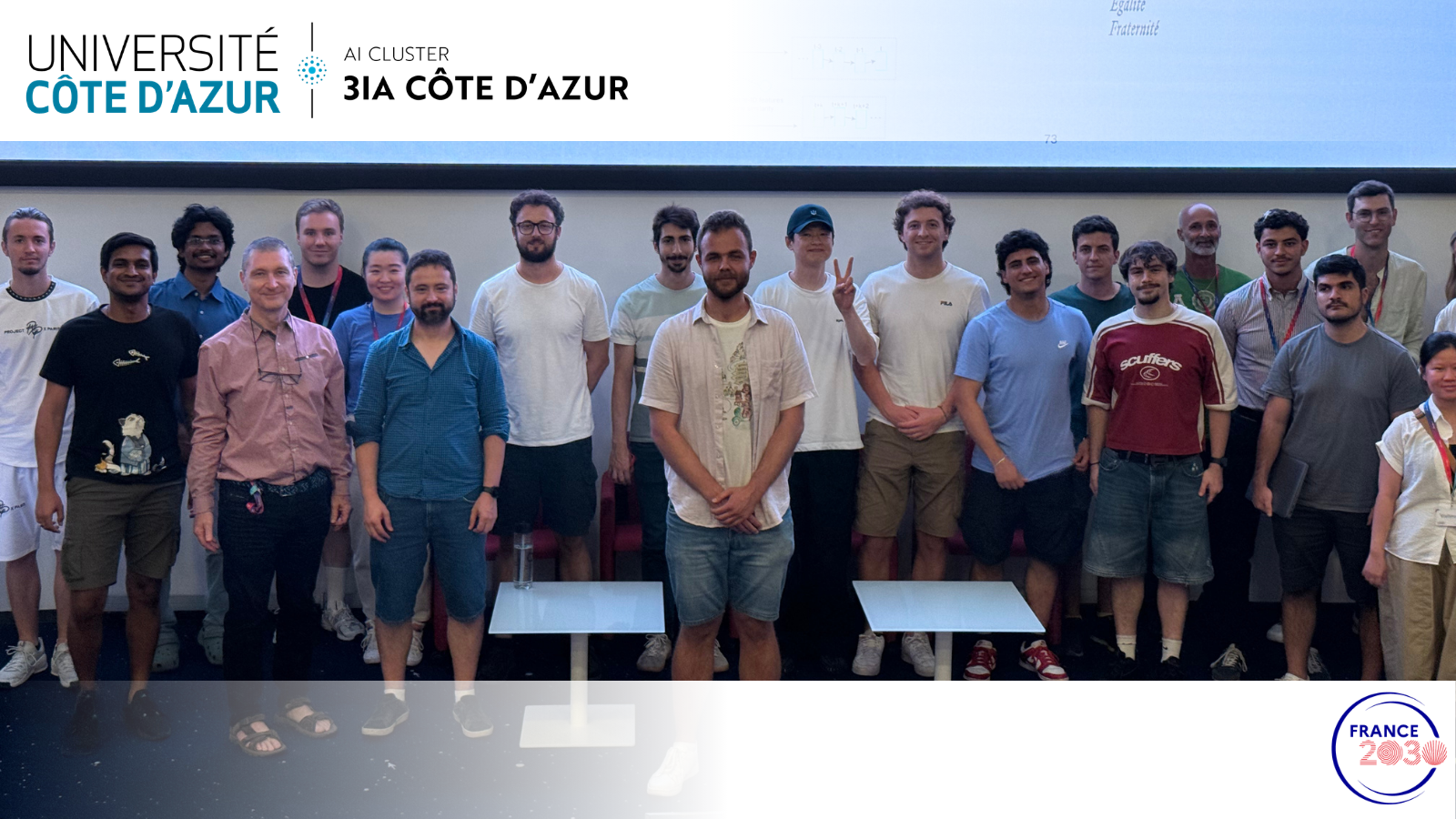
On July 1, 2026, Tomasz Stanczyk, a 3IA Côte d'Azur Ph.D. student supervised by François Brémond, successfully defended his thesis at the Centre Inria d’Université Côte d'Azur, proposing new design principles for robust, training-free multi-object tracking.
Tomasz Stanczyk (AI Cluster Ph.D. student, Inria) defended his thesis, titled "Training-free multi-object tracking: design principles for robust identity association and long-term tracking," as part of the 3IA Côte d'Azur research project Deep Learning methods for human behavior monitoring, supervised by François Brémond.
The jury was composed of:
Multi-object tracking (MOT) aims to estimate consistent trajectories for multiple targets across video sequences. While the field has advanced significantly, maintaining stable identities under occlusions, motion blur, appearance ambiguity, and camera motion remains a persistent challenge — particularly with fast-moving subjects, visually similar objects, and long-duration recordings.
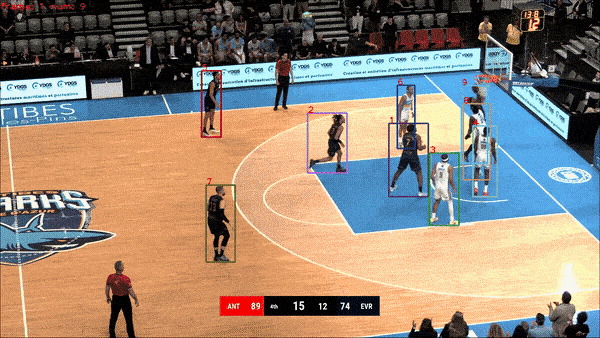
This thesis addresses these challenges through a combination of methodological development, empirical analysis, and benchmark design. It first examines the limitations of existing tracking-by-detection pipelines, including ambiguous associations, identity fragmentation, and difficulties in maintaining identities over long time spans.
Building on this analysis, the thesis introduces McByte, a framework that improves short-term association by incorporating temporally propagated segmentation mask information as an auxiliary spatial cue. This mask-guided mechanism helps resolve ambiguous detections and improves tracking stability in challenging scenarios.
The work also investigates the role of appearance-based re-identification in tracking pipelines, showing through controlled experiments that re-identification features do not always improve performance when applied indiscriminately — particularly for short-term association. This finding offers important design considerations for integrating appearance information into tracking systems.
To study identity preservation over extended durations, the thesis introduces WaspMOT, a new benchmark dataset for long-duration multi-object tracking, designed to expose challenges that shorter benchmarks often fail to capture.
Finally, these contributions are unified in McByte++, a framework combining lightweight mask-guided association, selective appearance-based identity recovery, and conditional camera motion compensation — improving tracking robustness while maintaining computational efficiency.
Overall, this thesis shows that effective multi-object tracking can be achieved through the careful integration of complementary cues, combined with evaluation protocols that explicitly address long-term identity preservation. 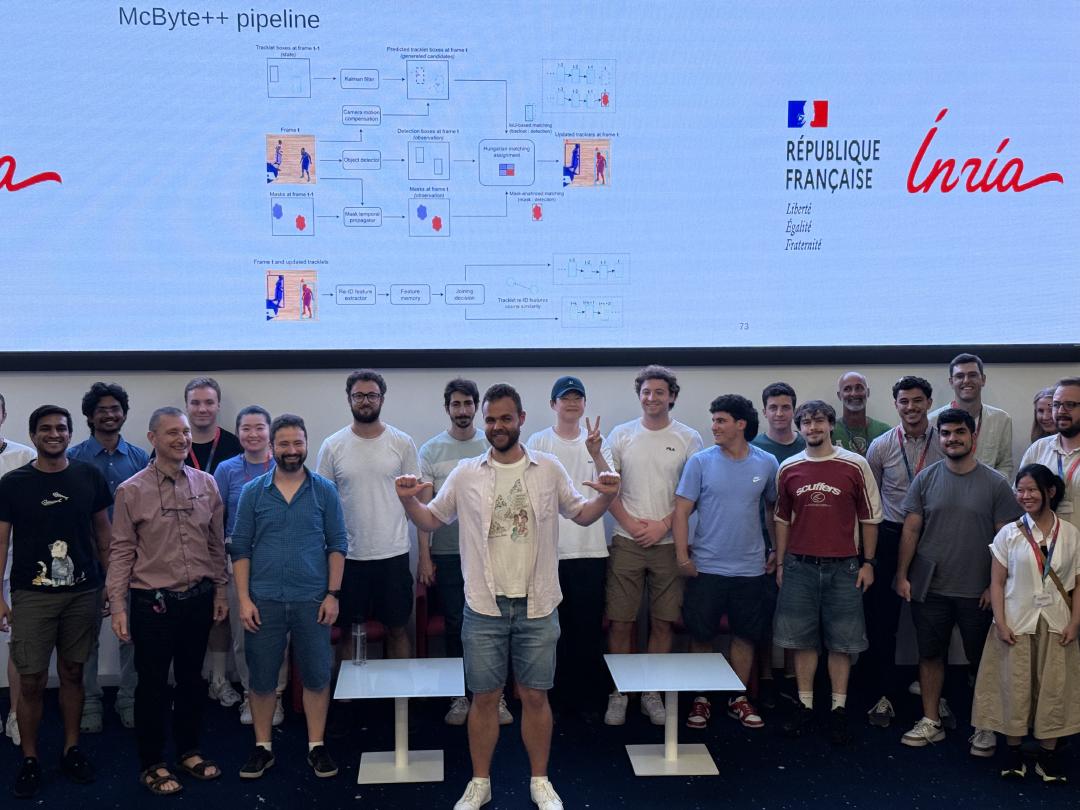
The jury was composed of:
- Ezio Malis (AI Cluster Chairholder), Director of Research, Centre Inria d’Université Côte d'Azur – Thesis Committee President
- Bertrand Luvison, Senior Research Engineer, CEA Saclay – Thesis Reviewer
- Carlos Crispim-Junior, Associate Professor, Université Lumière Lyon 2 – Thesis Reviewer
- François Brémond (AI Cluster Chairholder), Director of Research, Centre Inria d’Université Côte d'Azur – Thesis Supervisor
Multi-object tracking (MOT) aims to estimate consistent trajectories for multiple targets across video sequences. While the field has advanced significantly, maintaining stable identities under occlusions, motion blur, appearance ambiguity, and camera motion remains a persistent challenge — particularly with fast-moving subjects, visually similar objects, and long-duration recordings.
This thesis addresses these challenges through a combination of methodological development, empirical analysis, and benchmark design. It first examines the limitations of existing tracking-by-detection pipelines, including ambiguous associations, identity fragmentation, and difficulties in maintaining identities over long time spans.
Building on this analysis, the thesis introduces McByte, a framework that improves short-term association by incorporating temporally propagated segmentation mask information as an auxiliary spatial cue. This mask-guided mechanism helps resolve ambiguous detections and improves tracking stability in challenging scenarios.
The work also investigates the role of appearance-based re-identification in tracking pipelines, showing through controlled experiments that re-identification features do not always improve performance when applied indiscriminately — particularly for short-term association. This finding offers important design considerations for integrating appearance information into tracking systems.
To study identity preservation over extended durations, the thesis introduces WaspMOT, a new benchmark dataset for long-duration multi-object tracking, designed to expose challenges that shorter benchmarks often fail to capture.
Finally, these contributions are unified in McByte++, a framework combining lightweight mask-guided association, selective appearance-based identity recovery, and conditional camera motion compensation — improving tracking robustness while maintaining computational efficiency.
Overall, this thesis shows that effective multi-object tracking can be achieved through the careful integration of complementary cues, combined with evaluation protocols that explicitly address long-term identity preservation.