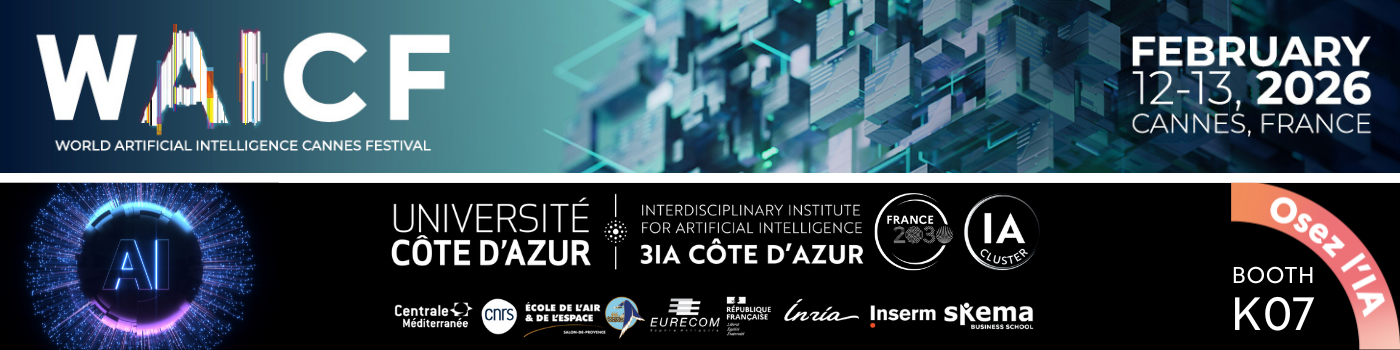
from February 12, 2026 to February 13, 2026
Booth K07
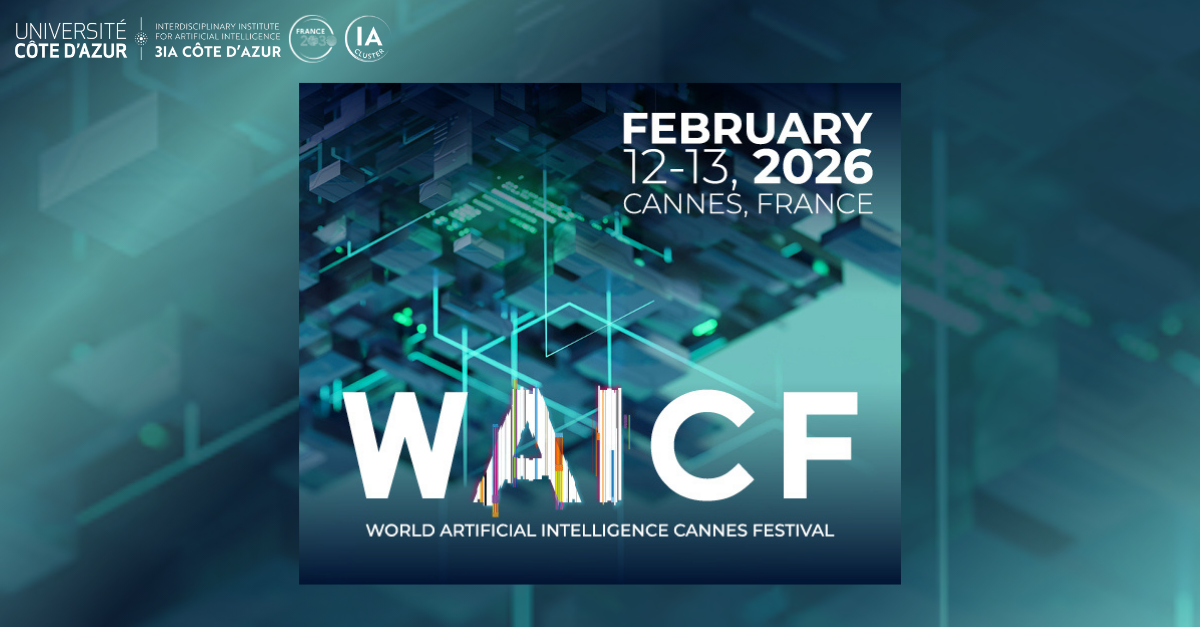
Meet the 3IA Côte d'Azur team at the WAICF 2026!
Come and discover start-ups emerging from academic research and engage in discussions about high-level AI scientific projects with top-tier researchers.
Connect with the AI academic elite that will scale-up your business on the 3IA Côte d'Azur booth K07!
Partnerships & innovation
Access to a world-class AI scientific expertise and engineering through R&D collaboration partnerships. We offer various collaboration schemes to accelerate your R&D and innovation project based on AI.
Contact our partnership teamSubmit a partnership proposal
PROGRAM OF THURSDAY FEBRUARY 12, 2026
- Events
-
▸ 9:30 am - 11:00 am
Welcome coffee and official photo
Reserved for 3IA Côte d'Azur consortium member institutions and the 3IA Côte d'Azur team (by invitation only)
▸ 2:00 pm - 3:00 pm
AI Ambassadors Networking Café
The 3IA Côte d'Azur teams will host the AI Ambassadors Network at their booth (by invitation only) - Innovation
-
▸ 1:00 pm - 2:30 pm
Facila, Qiulin Chen (AI Engineer) - Centre Inria d'Université Côte d'Azur
Title: AI-Based Analysis of Orofacial Muscle Function for Speech Therapy
Facila is an AI-powered tool designed to support speech therapists in the assessment and rehabilitation of orofacial myofunctional disorders.
Using computer vision and speech analysis, the demo shows how facial muscle movements and speech production can be analyzed in real time to support therapy exercises, patient follow-up, and objective feedback.
Facila is already used in clinical practice by speech therapists and patients, illustrating how AI can enhance everyday rehabilitation workflows.
▸ 2:00 pm - 3:00 pm
Eyenav Robotics, Minh Duc Hua (CEO) - CNRS
Title: Integration of Deep Learning and Nonlinear Automatic Control for Robust Perception and Autonomous Navigation of Underwater Robots
The work carried out by EYENAV ROBOTICS takes place in a context marked by the rapid growth of submerged and underwater infrastructures (offshore energy, telecommunications, maritime structures, aquaculture, etc.), which is driving increasing needs for inspection, monitoring, and intervention. These missions are conducted in complex environments, often under challenging sea conditions, where current robotic solutions quickly reach their limits. In response to these constraints, we have developed a new robust and high-performance technology for relative localization and local autonomous navigation. It is based on a combination of artificial intelligence and nonlinear control approaches, jointly exploiting forward-looking sonar (FLS) data and inertial measurements. Initial experimental results are very encouraging and open up promising prospects for a wide range of underwater applications.
▸ 3:00 pm - 4:30 pm
AI–DEtech, Marie Aspro (R&D engineer) - Centre Inria d'Université Côte d'Azur
Title: AI-DEtech: A new anomaly detection tool for sensitive industrial sites (supported by Naval Group)
On a shipyard, an error of just a few centimeters can delay the construction of an entire vessel. While the inspection of assembled parts still largely relies on the human eye, a new continuity is now emerging between human vision and artificial vision.
This project embraces that shift by transforming 3D scans into automated, reliable feedback — without the cloud, running on a standard computer, and designed for on-site operators.
A made in France and pragmatic approach, tailored to the needs of today’s sensitive industries. - Research
-
▸ 10:30 am - 12:30 pm
Ezio Malis (3IA Chairholder) and Shamik Basu (3IA Ph.D. student)
Title: Hybrid AI : Integration of Rule-Driven and Data-Driven Approaches for Enhanced Autonomous Robotics
The traditional methodology for developing intelligent autonomous robots relies on a rule-based approach, which involves creating a global model of the system, defining task-specific rules, and designing robust sensor-based control laws. While effective in controlled environments, this approach struggles with the complexity and dynamic nature of real-world environments due to the difficulty of capturing all necessary rules and parameters in real time. To address these limitations, we explore two solutions: enhancing model-based approaches through increased modeling fidelity, which may require intensive computations and therefore more efficient algorithms, and adopting data-driven approaches such as machine learning, which rely on large datasets and extensive training cycles. Data-driven methods, particularly those using artificial neural networks, learn from examples rather than explicit rules but face challenges related to data availability and the proof of stability and robustness. Our methodology aims to combine these two paradigms, creating hybrid AI systems that leverage the strengths of both approaches. The goal is to improve model fidelity using data-driven insights while constraining data-driven methods with accurate model knowledge, thereby ensuring theoretically proven stability and robustness in sensor-based control laws. This integration presents challenges, such as interpreting data-driven results to inform models and embedding model-based knowledge into data-driven systems, which requires the development of new architectures and explainable AI.
Mathieu Carrière (3IA Chairholder)
Title: From a comprehensive knowledge graph to topological data analysis: a novel framework to analyze gene regulatory networks to improve plant health
Plants live in a constantly changing environment, consequently they are exposed to multiple stresses. In particular tomato, (Solanum lycopersicum), despite being among the most important vegetable crops worldwide, yet it remains highly vulnerable to over 200 diseases caused by different pests. Although the molecular response of tomato to individual stresses is well studied, the gene regulatory network (GRN) representing the crosstalk and trade-offs of multi-stress responses remains almost unexplored. To tackle this question, we developed the GENIAL (Gene rEgulatory Network and topologIcal datA anaLysis) framework to refine and analyze complex GRNs. Since to build the GRN we need to retrieve information about known molecular interactions in tomato, first we developed a knowledge graph. TomTom gathers molecular interactions from eleven publicly available databases, including transcription factors (TF)- or microRNAs- targets, protein-protein interactions, and functional annotations in a unique FAIR resource. To test the potentiality of GENIAL to study the molecular multi-stress response, we used transcriptomics data from tomato subjected to six distinct pathogens from the literature. By using only one layer of TomTom molecular interactions, namely the TF-targets, we extracted a fingerprint GRN representing the single and multiple pathogens response. To analyze this complex GRN we complemented our framework with tools from the topological data analysis. Using the Mapper algorithm, we encoded the topological structures within the GRN and using ToMATo, we identified 18 hot spots of TFs sharing targets. By crossing those structural hot spots with the TF activities, we identified four clusters corresponding to different configurations of the core and specific of tomato multi-stress response. Overall, GENIAL yielded the identification of novel and known TFs and pathways coordinating the tomato multiple pathogens response. This study represents a proof of concept of our novel framework and can be easily extended to include other molecular layers and is also scalable to other questions involving tomato and beyond.
Joint work with Silvia Bottini
▸ 2:30 pm - 4:30 pm
Marc Vesin (R&D engineer) and Lucie Chambon (Research Engineer), both from Centre Inria d'Université Côte d'Azur
Title: Fed-BioMed:Open, Transparent and Trusted Collaborative Learning for Real-World Healthcare Applications
Fed-BioMed is an open-source research and development initiative for translating collaborative learning into real-world medical applications, including federated learning and federated analytics.
The community of Fed-BioMed gathers experts in medical engineering, machine learning, communication, and security. We provide an open, user-friendly, and trusted framework for deploying the state-of-the-art of collaborative learning in sensitive environments, such as in hospitals and health data lakes.
In this session we will present the components of Fed-BioMed, and will give a demonstration of the platform on relevant use-cases in healthcare, including federated learning on tabular and imaging data.
▸ 4:30 pm - 6:00 pm
Raphaël Troncy (Assistant Professor in the Data Science Department, EURECOM)
Title: Equip Your Agents with a Structured World Model
The rise of context graphs and Graph RAG reflects a deeper shift in AI: From pattern completion to structured grounding. As models become cheaper and more ubiquitous in 2026, the bottleneck is no longer generation, but contextualization. In the context of the LettRAGraph project, EURECOM and the startup Lettria are building tools that enable to transform unstructured natural language into dynamic knowledge graphs, that can optionally adhere to strict schemas and ontologies that capture the enterprise domain knowledge. This enables in turn AI agents to reason, plan and traverse complexe relationships with ease. In this talk, I will present the Perseus model (https://docs.perseus.lettria.net/), built on top of the Gemma 3 suite, that outperforms all major open weights as well as closed source large language models in building knowledge graphs that adhere to known schemas. The resulting graph-based representations offer a principled way to manage knowledge, memory, and reasoning across time, tasks, and agents.
Stéphane Petiot (Full Stack Engineer, 3IA Côte d'Azur Techpool)
Demos - Training
-
▸ 9:00 am - 6:00 pm
EURECOM
Lise Cudin, Head of communication
Laura Thor, Digital Communications Manager
Skema
Valentine Massa, Undergraduate admissions Manager
École de l’air et de l’espace
Jérémy Buisson (Associate professor)
Centrale Méditerranée
Anne-Laure Méalier (Centrale Digital Lab Education Manager)
▸ 12:30 pm - 1:00 pm
Presentation of the new Skema Bachelor’s degree in “AI and Management” (launching in September 2026)
Christophe Germain (Vice-dean of Skema Business School)
▸ 1:00 pm - 2:00 pm
Overview of the Centrale Digital Lab program / Industrial and academic collaborative projects
Florine Draillard (Corporate Relations, Professional Integration and Apprenticeship Tax Office at Centrale Méditerranée) and Anne-Laure Mealier (Centrale Digital Lab Education Manager) - Partnerships
-
▸ 9:00 am - 6:00 pm
3IA Côte d'Azur
Alain Prette (Head of Innovation and Partnerships)
Centre Inria d'Université Côte d'Azur
- Nadège Camelio-Laurent (Partnerships and innovation projects Officer)
- Anthony Schoofs (Head of Technology Transfer, Innovation and Partnerships)
Inria Startup Studio of Centre Inria d'Université Côte d'Azur
Stephanie Morales (Startup Manager)
CNRS
Laurence Cottaz (Technology Transfer Engineer)
Centrale Méditerranée
Florine Draillard (Corporate Relations, Professional Integration and Apprenticeship Tax Officer)
PROGRAM OF FRIDAY FEBRUARY 13, 2026
- Innovation
-
▸ 1:30 pm - 2:30 pm
Eliesh Sahyoun (FHH Project leader, User eXperiences for Smart Life chair)
Title: Prometheus
Prometheus is an AI-driven co-design tool that supports architects, developers, and decision-makers in integrating nature-based solutions, informed by systemic biomimicry, into building design processes. Trained on precedent systemic biomimetic projects, biological observations from Parc Phoenix, environmental performance data, and simulation outcomes generated through the FHH toolkit, the system generates adaptive passive climate strategies and design recommendations. By combining knowledge retrieval, generative design, and performance optimization, Prometheus brings forward innovation and enhances sustainability, climate responsiveness, and ecological integration within built environments.
▸ 4:30 pm - 6:00 pm
AreWeMe, Tanay Agrawal (Project Leader) - Centre Inria d'Université Côte d'Azur
Title : What is culture and how can we define test and mould it?
The talk will be about how culture is a word that i commonly used and is attributed to groups, but it is actually made of individual beliefs and values and identifying these key beliefs and values amongst others has a lot of applications which we are presenting as a tool. - Research
-
▸ 09:30 am - 10:30 am
Vincenzo Marciano (3IA Ph.D. student)
Title: Can we trust AI when it comes to healthcare?
The increasing reliance on AI in medical imaging has introduced significant advancements in diagnostic accuracy and treatment planning. However, once deployed, the effectiveness of these AI-driven models must be continuously validated to ensure their reliability in clinical settings. This raises the question: Can we trust AI in medical imaging? The need for rigorous quality control (QC) models is imperative to assess the performance of nowadays segmentation algorithms. These QC models must be capable of evaluating the accuracy and consistency of AI-generated segmentations, ensuring that they meet clinical standards.
Vincent Vandewalle (3IA Chairholder)
Title: Statistical models for organizing complex data
Faced with the diversity of information we produce – survey responses, purchasing habits, medical records, or temperature curves – it is not always easy to make sense of it all. Clustering methods offer a way to bring meaning to this complexity by grouping data according to their similarities. Whether qualitative (preferences, opinions), quantitative (numerical measurements), or even functional (changes over time), these approaches reveal hidden groups within the data. This demo will provide a concrete overview of how they work and show how they transform a stream of raw data into more readable categories.
▸ 10:30 am - 11:30 am
Pierre Alliez (3IA Chairholder) and Merve Asiler (3IA Postdoctoral researcher)
Title: Learnable representation of 3D meshes
In this demo, we will present PoNQ, an innovative mesh representation based on 3D points enriched with normals and quadric error metrics (QEM). These points are predicted by a neural network, then automatically connected by triangles via Delaunay triangulation, ensuring a mesh without self-intersections that is always closed. We show how PoNQ enables surface reconstruction from SDF grids (signed distance fields), with results that surpass recent methods, both on surface quality criteria and edge accuracy metrics.
▸ 10:30 am - 12:30 pm
Jean-Pierre Merlet (3IA Emeritus Chairholder)
Title: NN-PES, a neural network parametric equations solver
In science and engineering it is needed frequently to consider a parametric system of equations F(X,P)=0 where X is a vector of unknowns and P a vector of parameters and to determine for a given P what are the solution in X of the equations and to repeat this solving for a large number of different P while the number of solutions for a given P is not known in advance. NN-PES is a generic neural network approach for this problem. It requires only as input a few examples of
solutions(s) Xi for given Pi and automatically constructs a set of neural networks using a specific training strategy that in turn will be used to produce exact solutions for any P provided that the set of possible P is bounded. This leads to a very fast solver and although we cannot guarantee to obtain all solutions for a given P NN-PES has a self-learning mechanism that allow to improve it over time.
▸ 11:30 am - 12:00 pm
Jean-Luc Dugelay (Professor in the Digital Security Department, EURECOM)
Title: Generation of audio/video deepfake and Detection
We will show how it is now possible to create real-time audio/video deepfakes using easy-to-use public software. Participants would stand in front of a camera and a microphone and act as pilots to puppeteer a celebrity by face-swapping and audio cloning. The audience would be able to see the output on a large screen. In addition, we will explain our ongoing R&D activities, within the context of the French National Collaborative Project AID DeTOX, to fight against the proliferation of deepfakes by designing optimal detectors.
▸ 12:30 pm - 2:00 pm
Giulia Foroni (3IA Ph.D. student)
Title: How Connected Is Too Connected? A Graph Perspective on Cancer Survival
▸ 12:30 am - 1:00 pm
Francesco Castellaneta (Professor of Strategy and Entrepreneurship, SKEMA Business School and Université Côte d'Azur - GREDEG)
Title: Collective Intelligence Through AI: Evidence from Private Equity
The resource-based view (RBV) typically assumes that accumulating proprietary data improves firms’ predictive models and performance. We argue that in data-intensive settings this logic is bounded by a data paradox: reliance on afirm’s own history creates data traps that refine models around a narrow experiential slice and obscure patterns that appear only in other firms’ experience. We theorize collaborative meta knowledge—algorithmic abstractions distilled from proprietary data that preserve predictive relationships while substantially limiting disclosure of underlying records—as a strategic asset that enables cross-firm pattern access without direct data sharing. Leveraging rare access to Limited Partners’ records, we assemble 11,130 buyout transactions for 388 private equity firms and simulate a federated model sharing regime that operationalizes collaborative meta knowledge: 89 firms each contribute their best-performing locally trained model to a shared pool and then select the model that best predicts their own future deals. Ninety-two percent of firms would improve predictive accuracy by adopting external models; external models frequently outperform internal models on a firm’s own investments; and performance gains are highly asymmetric across firms. These results identify a boundary condition for databased advantage and show that competitive advantage in predictive performance can depend less on exclusive data possession than on access to heterogeneous algorithmic patterns and on the capability to orchestrate them.
Eliesh Sahyoun (FHH Project leader, User eXperiences for Smart Life chair)
Title: Future Human Habitat (FHH) : Collective Intelligence (CI) vs Artificial Intelligence (AI) ?
The User eXperience (UX) for Smart Life Chair, through its FHH project, looks ahead to 2065 to anticipate, learn from, and design human-centered habitats. This proactive approach aims to shape future scenarios, explore new possibilities, and stimulate innovation and growth for nowadays through disruption.
So far, through a scientific process, three probable, possible, and plausible scenarios have been developed using qualitative and quantitative data, as well as collective intelligence. In light of emerging AI trends, we have initiated research to examine the potential existence of biases in AI tools representing different geopolitical and technological spheres of influence: ChatGPT (USA), DeepSeek (China), and Mistral (FRA).
This research replicates the same scenario-building process while replacing collective intelligence with different artificial intelligence systems, enabling a comparison between the original scenarios and the AI-generated ones.
▸ 1:00 pm - 1:30 pm and 2:00 pm - 3:00 pm
Stéphane Petiot (Full Stack Engineer, 3IA Côte d'Azur Techpool)
Demos
▸ 1:30 pm - 3:00 pm
Paolo Papotti (3IA Chairholder), and Francesco Dente and Dario Satriani (Ph.D. students, EURECOM)
Title: How LLMs can support the entire software engineering lifecycle
We will demo two systems to assist software engineers with AI in their workflows.
Text2Stories is a tool to evaluate the grounding of software requirements (user stories) against stakeholder interviews, assessing coverage, traceability, and soundness.
API-Bench is a benchmark to evaluate whether AI agents can reliably extend real-world backend systems by implementing new functionalities from precise OpenAPI specifications.
▸ 3:00 pm - 4:30 pm
Omid Esrafilian (Lead Research Engineer, EURECOM)
Title: Flying autonomous 5G networks
This demo showcases the solutions developed at the Drone4Wireless laboratory at EURECOM, demonstrating how the integration of flying robots can enhance cellular networks. The presented systems enable a wide range of services, from accurate localization to extended and adaptive network connectivity, highlighting the role of aerial platforms in future wireless infrastructures.
▸ 4:30 pm - 6:00 pm
Xioming Zhang and Matteo Pentassuglia (Ph.D. students, EURECOM)
Title: ERC Consolidator CARAVEL – Extraction, Modelling and Analysis of the Brain Vessel Tree
CARAVEL is an AI-driven research effort currently developing new ways to understand how the brain’s vascular system evolves with age. By building advanced AI methods for large-scale, multi-resolution analysis of neurovascular imaging data, the project is working toward the first atlas of brain vascular ageing, opening new paths for fundamental brain science.
Rafael Silva (3IA Ph.D. student)
Title: Frugal AI for Miniaturized Cardiac Defibrillation
Developed in collaboration with Inn’Pulse and 3IA Côte d’Azur, this work presents a frugal artificial intelligence approach for real‑time cardiac rhythm analysis in portable defibrillators. We developed a lightweight deep learning model optimized for low‑power microcontrollers, achieving over 99% accuracy while maintaining low latency and energy consumption. This solution shows how compact neural architectures and quantization enable reliable clinical‑grade AI performance on low‑cost embedded hardware, opening the door to more accessible and intelligent life‑saving technologies. - Training
-
▸ 9:00 am - 6:00 pm
EURECOM
Lise Cudin, Head of communication
Laura Thor, Digital Communications Manager
Skema
Stéphanie Nouet, Admissions and Candidate Relations Officer
École de l’air et de l’espace
Jérémy Buisson (Associate professor)
Centrale Méditerranée
Anne-Laure Méalier (Centrale Digital Lab Education Manager)
▸ 1:00 pm - 1:30 pm
Eliesh Sahyoun (FHH Project leader, User eXperiences for Smart Life chair)
Title: “Futures Experimental Lab” (FEL)
FEL is a futures simulation laboratory that invites transdisciplinary professionals, researchers, and students—including architects, designers, engineers, and speculative thinkers—to participate in a two-week nomadic, hands-on living laboratory. The lab provides a space to explore, stimulate, simulate, and test disruptive ideas for the “Brave New World” of future living, where humanity thrives in extreme environments such as oceans, deserts, space, high mountains, and deep-earth habitats.
The lab emphasizes three forms of “intelligens”: Environmental (systemic biomimicry), Artificial (AI tools for the design process), and Collective intelligence. It also promotes seven modes of thinking: systemic, design, critical, divergent, creative, future, and exponential thinking. FEL is driven by non-formal education methodologies that encourage experimentation, collaboration, and speculative design.
The first edition, held in July 2025, was entitled “5 Oceans, 5 Colonies: Sculpting Future Living Architecture On and Below Water.”
Link
▸ 1:00 pm - 2:00 pm
Presentation of the specialized master's programs at the École de l’air et de l’espace
Jérémy Buisson (Associate professor) - Partnerships
-
▸ 9:00 am - 6:00 pm
3IA Côte d'Azur
Alain Prette (Head of Innovation and Partnerships)
Centre Inria d'Université Côte d'Azur
- Nadège Camelio-Laurent (Partnerships and innovation projects Officer)
- Anthony Schoofs (Head of Technology Transfer, Innovation and Partnerships)
Inria Startup Studio of Centre Inria d'Université Côte d'Azur
Stephanie Morales (Startup Manager)
CNRS
Laurence Cottaz (Technology Transfer Engineer)
Centrale Méditerranée
Florine Draillard (Corporate Relations, Professional Integration and Apprenticeship Tax Officer)